

Ascent Axe 80: WA-Built Offshore Powerhouse

The outstanding quality and professionalism of the West Australian recreational boat building industry deserves spades of accolades, none more than the crew behind the recently launched Ascent Axe 80, as BARRY WISEMAN discovered.
THOSE fishos who joined the annual Western Angler Seafari to the Mackerel Islands off Onslow in August last year were among the first to set eyes upon this plate aluminium work of art from Ascent Marine at Hamilton Hill, south of Fremantle.
Daniel Roberts, a keen diver and fisher who has been in the shipwright industry for more than 16 years is managing director, and he is quick to praise his team of 10 who bring their skills together to produce high-quality plate aluminium vessels such as the Axe 80.
The team comprises naval architects, metal fabricators, technicians, interior designers and upholsterers, plus marine paint specialists.
Supported by apprentice trades people, everything is conducted in-house at their premises in Emplacement Crescent.
Their recreational fleet includes the Axe 80 featured in these pages, its big brother the Axe 95, plus the Ascent 665, a popular size for many boaters.
Ascent Marine’s commercial vessels include the Patrol AS 70 and 80 featuring the high-density foam D-collar design favoured by sea rescue groups and government agencies.
The Rescue RIB is another vessel delivering exceptional performance in safety operations.
The company’s designs provide each model with the longest waterline length possible to increase on-water performance, with less drag and more lift to reach cruise speeds faster.
Better top speeds are possible from whatever motor the customer orders.
I met Daniel at the public floating pontoon at the Woodman Point boat ramps, as he had driven the vessel from its nearby berth.
Immediately I could clearly see one obvious design feature.
The shape of the bow protruding forward, unlike most vessels.
Joining Daniel on the Axe 80, my first question was obvious. Why?
“Our design team was looking for the longest waterline length possible to increase sea state performance,” he explained.
“We have also introduced a stepped hull and that changes how the boat interacts with the water flow.
“Each hull on the Axe 80, Axe 95 and the Ascent 665 range has been designed with two steps below the waterline.
“Unlike a regular boat, a stepped hull has notches or indentations from port to starboard, forcing water flow to separate from the hull and reduce the contact surface.
“They also create more air under the vessel to give it increased lift at reduced speeds.”
All absolutely true. Words I have heard before, but more likely from the manufacturers of big fibreglass cruisers and motor yachts.
Ascent Marine has used computational fluid dynamics (CFD) techniques on the aluminium design to enhance hull performance, aiming to reduce hull drag, stability, fuel reduction, improved top speed and rideability.
Stepping aboard the Axe 80 and noticing the features on this vessel for fishability and general family life on the ocean, the designers and trades people must be congratulated.
“After eight months of hull design, our CFD simulations and making alterations, our findings include increased stability at rest as well as high speeds; improved stability in poor seas; variable fuel reduction of 10 per cent at low speeds to 40 per cent at top speed.
“Engine load is reduced to between 15 and 30 per cent; and we have a top speed increase of 15 per cent plus.”
On Cockburn Sound this morning with Daniel at the wheel, we were planing at 10 knots and reached a cruising speed of 30 knots within a matter of seconds.
Later heading back to port, we topped 52 knots from the twin Mercury Verado 300hp motors on the transom.
Being 8m in length plus a beam of 2.9m, road travel is restricted to daylight hours with oversize signage evident.
Not a problem for the anglers heading to Thevenard Island, as Daniel pointed out.
“Too many roos and emus to be driving at night while heading north,” he said.
Plus, the Western Angler Seafari includes overnight motel accommodation and dinner in Carnarvon, along with a few tall fishing yarns.
Since getting the bottom wet at the Mackies this Axe 80 has made the coastal voyage to Geraldton and back, deploying its outriggers along the way.
Below deck there are two 430-litre kill tanks.
One can be used for storage while the other is ready for the next pelagic to take the lure.
On the centreline aft, there is also a 550-litre hatch for general storage.
The fuel tank holds 740 litres, plus there’s 140 litres of fresh water onboard hooked up to a sink and shower on the transom.
The vessel has been fitted with Evercor Marine Decking, a natural cork composite material 4.5mm thick.
“It was designed and made here in Perth and suits our application perfectly,” Daniel said.
“It doesn’t get hot and it’s more durable than the high-density foam products used widely these days.”
Its honeycomb embossed design works well with the upholstery of the two large lounges mounted each side of the cockpit, behind the helm and passenger deluxe armchairs.
The non-skid composite is also used widely on the coamings and gunwales of the Axe 80.
My eyes soon focussed on the bait station aft.
It’s big and beautiful, with built-in knife slots, drink/sinker holders, and a split cutting board with lift-up access to the sink.
On the starboard side, there is a large plumbed live tank with glass front, big enough for several crays or fish for the dinner table when anchoring overnight.
There’s a saltwater deck-wash pump to wash your hands and keep the bait area clean.
Five rod holders are mounted at the rear, plus more drink/bottle holders.
A folding transom seat can be removed completely, along with the upholstered coaming cushion which acts as a back/neck rest when the seat is in use.
Side pockets run the full length of the cockpit and come with rod racks, long and short butted.

Under the cockpit lounges, a pair of Isotherm 100-litre Inox drawer fridge units have been installed, keeping food and drinks cold or frozen for lengthy stays aboard.
The Axe 80 is rated to take nine people, with twin bunks up front in the step-down cabin.
An infill cushion converts the bunks to a large double berth, with plumbed toilet underneath.
The interior walls are soundproofed with carpet, plus there is privacy with the soft canvas door.
When left open for ventilation, the canvas is rolled up and secured with magnetic strips, while bedding is stored under the bunks.
Adding to its sleeping capacity, the upholstered lounges in the cockpit convert into a double bed with the addition of a collapsible dining table which drops into a slot in the deck.
Plus, there’s plenty of space on the rear deck to throw a couple of swags down for the night.
The Ascent Axe 80 is very capable of offshore cruising, with solar panels on the roof to top up the batteries while anchored up.
The cabin top also doubles as a roof rack to secure swags between the sturdy handrails.
With the outrigger setup, there’s still more than enough room so as not to interfere with the pole base security points and the LED bar light used to illuminate the foredeck and beyond at night.
The bow section has a flush-fitted electric capstan winch and anchor cradle, with low profile rails used for securing mooring ropes.
There’s a forward ventilation hatch in the cabin roof, also giving access to the anchor and forward bollard when required.
At the transom, the large marlin boards also come with the cork composite decking and cater for bathers and scuba divers, with a folding ladder on the port side.
The single hose fit-up for the twin Mercury Verado motors gives ample room to walk the marlin boards.
The hydraulic lines for the steering system have access points built into the marlin platform, along with a sealed inspection hatch.
The workmanship on the Axe 80 is first class and the operational area for the skipper and co-pilot is exceptional.
Having grown up around boats, Daniel initially specialised in the composite construction and modification industry in WA before he travelled to England to work on superyachts.
He has also been a competitive sailor for many years, winning state and national titles.
Those same skills in managing a yacht single-handed have been introduced into the design of the Ascent fleet, as is evident when you stand at the wheel of the Axe 80.
Vital operational components are within easy reach.
The remote control for the engines is bolted to a binnacle which is recessed at 45 degrees into the starboard cabin wall.
The controls are at a natural arms-length when standing and the operational lights are easily visible.
The ignition key switch (two in this case) is located within the recess and away from children’s hands, plus the cave-like shelf keeps your car keys and other valuables safe and dry.
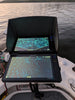
The highly polished acrylic dash facia holds the twin Simrad NSS12 Evo3S units with a bank of switches to control the cockpit and flood lights, forward and aft bilge pumps, electronics, and auto pilot.
All are clearly marked and easy to reach.
Nearby are toggle switches for the anchor winch, trim tabs, and Fusion audio system.
A similar display is located on the passenger side, with 13 illuminated push-button switches for the anchor, cabin, gunwale, and underwater lights; the freshwater pump, fridges, plus the master switch for the electric fishing reel plugs located in the walls of the rear deck.
Simple and easy to find.
“I’m not a fan of the digital switch system found within the electronics display,” Daniel explained.
“You’ve got to go into the display unit and then find what you’re looking for. I prefer to have the controls within easy sight and reach.”
The deluxe armchair skipper and passenger seats have reverse backs rather than being mounted on swivels and the arm rests help keep people securely in their seats.
Bolster cushions support the lower back when standing.
There’s more storage in the seat box hatches below.
The Ascent Axe 80 is a credit to the team that has produced this true offshore family/fishing package.
A great deal of thought has gone into the design and its obvious they themselves are boating and fishing enthusiasts.
For added strength, 8mm keel stringers run full length from the bow to the 23-degree deadrise transom.
“By the way, we named the design Axe due to the shape of the battle axe hull,” said Daniel as I stepped off back at Woodman Point.
NUTS & BOLTS
MODEL: Ascent Axe 80
LENGTH: 8.01m
BEAM: 2.9m
FUEL: 740 litres
HP: Twin Mercury Verado 300hp
FRESH WATER: 140 litres
CAPACITY: Nine people
BOTTOM: 6mm
SIDES: 5mm
TOP: 4mm
WEIGHT: 3245kg (dry); 4030kg (wet)
CRUISING SPEED: 35 knots
MAX SPEED: 52 knots
MANUFACTURER: Ascent Marine; 4/25 Emplacement Cres, Hamilton Hill; Ph: 9433 1018; www.ascentshipwrights.com
PRICING: $600,000 as tested. From $500,000
PROS & CONS
PROS
- Excellent stability, high freeboard and interior safety, solid construction.
- Rapid planing speed, aided by stepped hull construction.
- Family getaway boating with game fishing capabilities.
- Much thought to helm design.
- Spacious interior and rear deck.
- High quality craftsmanship.
- Coastal cruising in mind.
CONS
- Heavy duty trailer required, plus oversize towing signage.
- High freeboard is an excellent safety feature. Mature aged people could well request a starboard side door for easy walk-on access.