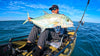
Urban Fishing Done Right: A Lesson from the UK

While the City of Stirling was acting with great haste to stop kids from fishing lakes and ponds within its borders, I was having precisely the opposite experience on the outskirts of London.
Where the City of Stirling seeks to ban mainly young anglers from its waters under the guise of conservation, ignoring the fact that it does not appear to have the actual legal ability to enforce its ban, I was a guest of an English fishing club that seeks to encourage anglers of all ages to fish in manmade lakes.
I had read about fishing gravel pits in England in a couple of books, intriguingly both written by rock stars – the late Ozzy Osbourne and Iron Maiden guitarist Adrian Smith.
I could never quite picture in my head what that meant, until my day fishing with the Reading and District Angling Association (RDAA).
My old mate and former British MP Martin Salter had invited me, once again ignoring his distaste for the fact that Australia still holds the Ashes to extend the olive branch of friendship to one of his Antipodean underlings.
It was the RDAA’s annual open day at a place called Farnham Flint, which is a series of lakes that it turns out were originally bare gravel pits – holes in the ground dug out to provide foundations for nearby major roads.
Nowadays they look a lot more natural, as time has seen nature take over, and they are fringed by greenery and home to a variety of fish species, most notably carp to over 20 pounds in the old.
Here, members can fish using bait, fly or lure to catch their preferred species.
There were plenty of people catching carp when I arrived and what surprised me was that they were catching them on the surface, where I have always thought of them as a strictly bottom feeder.
Martin explained that the trick was to bring them to the surface with pellets.
He kindly lent me a fly rod and a bag of pellets and sent me on my way to one of the back lakes to try my luck on some bigger fish.
While the City of Stirling has been worrying itself with humans harming birds, the scenario was reversed at Farnham Flint, as I soon found my attempts to berley up carp were foiled by very aggressive birds that were quick to snaffle any pellets I threw out.
Geese, swans and black-headed gulls joined in and all attempts to distract them or guide them to other parts of the lake failed.
One of the swans didn’t take kindly to our refusal to feed it, rising up high on its back legs, spreading its wings and hissing very aggressively!
After a while we gave up on that plan and retreated back to one of the easier lakes to fish, where they’d been feeding the smaller carp pellets all day.
A few handfuls of pellets soon had carp back on the surface and it was entertaining watching these large mouths extend up to suck down their food.
I had my fly drifting amongst the pellets and soon found they were harder to hook than you’d think, even when I watched a large mouth inhale my offering.
Eventually though I was able to connect with one of these fish and finally landed a hard-pulling carp of around three kilos.
My first carp on fly!
Just when things were heating up the geese found us again and stumps were drawn to conclude an entertaining day that showed how much fun this type of fishing can be (when it’s allowed).
The good folk of the Stirling council may be shocked to learn the RDAA actually views fishing as a very worthwhile pastime for the local kids and encourages it, charging youngsters aged 6-11 just five quid to join annually, while it’s 10 quid for those aged 12-17.
For that, they have access to Farnham Flint, with 40 lakes and a river section, for a year and can enjoy the sort of urban fishing experiences that some people in WA seem to want banned.
A visit to a UK fishing club paid off with this nice carp on fly in what was once an abandoned gravel pit.